
Issue 26: Last One
Summer discounts galore, a farewell tour of Ōtepoti & Critic's oldest living editor
Haere mai, suckers. Welcome to The Lowdown, your weekly round-up of each issue of Critic Te Ārohi.
Whether you’re a current Otago Uni student who couldn’t be bothered walking down the road from their flat to pick up this issue, a nosy alumni who can’t let go of the good old days, or a head-hunting Real Journalist keen to see what the youths are getting up to these days, please enjoy slurping up the latest gossip from the most notorious university student magazine in Aotearoa. We’ve been doing this sh*t for 100 years.
The Lowdown for Issue 26: In news, Exec reports Part II sees more honorarium cuts, job-seeking students say “bullshit” to Luxon’s abundance-of-employment claims, promposals sweep North D, and skilled students snag Blues and Golds awards. In features, the story of Critic’s oldest living editor at 94, Paul Oestreicher. In culture, the tattoo artist behind the cover, a summer discount list across the motu, a farewell tour of Ōtepoti (sea shanties and skulls included), and can you guess which Critic interviewee said what? But first, Nina get’s sentimental in her final editorial.

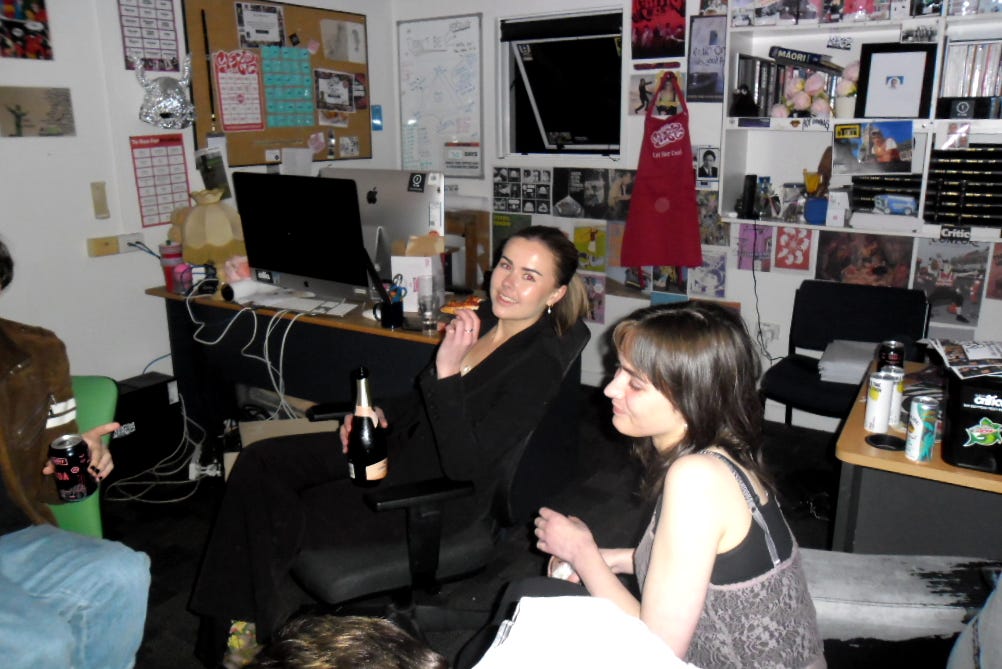
Editorial: Long Live Critic
There have been many versions of this editorial – my last.
First was the list of evidence I’d compiled for the eventual case to be made that I’ve aged out of studenthood, including the visceral shock of a newly elected Execcie at my date of birth. Next was what I could only describe as an Oscar “thank you” speech. Overcome with sentimentality and love for the magazine that’s been my sole purpose these past few years, I tearfully expressed how simultaneously relieved and saddened I would be to leave. I then switched tact into a confession piece titled ‘Cat’s Out of the Bag, I Don’t Care About Castle St’. If I wasn’t going to be sentimental, I was going out with a bang.
Mid-way through drafting this editorial, I had the privilege of reading Iris’s feature article, a profile of our oldest living editor at age 94. I was reminded how, while Critic does its best not to take ourselves too seriously, we do have an important purpose: to hold the University and OUSA accountable, platform the voices of the student body, add to the historic record of Otago Uni, and provide a good laugh and procrastination material. I think we’ve done a pretty good job.
I still recall asking Fox Meyer, who was the editor when I began, how he found enough content to fill a magazine a week. “It’s hard,” he replied. And it’s clear that after three years – starting as a fledgling reporter in third-year, News Editor in fourth-year, and two years as the full-time Editor – I’ve wrung all the content I can muster out of my Otago experience. My notes app, once full with ideas penned at midnight when I couldn’t sleep, has dried up. I’m so grateful to have had this privilege, especially in Critic’s 100th year. Thank you for reading, and long live Critic, you old bastard.
By Nina Brown
The Stories
OUSA Quarter 3 Wrapped: Part II — At last week’s Exec meeting, the last half of the quarter three reports were approved. Here’s what those Exec members got up to to get paid for their honorarium (i.e., top-up their StudyLink). It was a drama-filled quarter for many, but here’s what the Exec were doing when Critic Te Ārohi wasn’t reporting. (By Gryffin Blockley)
Job-Seeking Students Say “Bullshit” to Luxon’s Employment Claims — Prime Minister Chris Luxon and Minister for Social Development Louise Upston announced last week that the Government will be imposing further restrictions for Jobseeker applicants. The news sparked an influx of national headlines speculating whether Luxon’s “tough love” approach was a warranted push for youth into employment, or a concerningly out of touch policy that punishes young people for an economic crisis they didn’t create. Unemployed Otago students say it’s the latter. (By Nina Brown)
Skilled Students Snag Blues and Golds — The annual Blues and Golds awards were held last Thursday to celebrate cultural and sporting achievements of Otago tauira. The yearly ceremony is a collaboration between the University and OUSA, proving just how well some students are able to lock in. In total, 56 individuals or clubs got an award. Ka pai to all involved. (By Gryffin Blockley)

Promposals Sweep North D — A group of exchange students swapped their jorts and scuffs for black tie attire on Saturday, October 4th to bring American-style proms to Ōtepoti. Complete with elaborate promposals, the classic awkward photos, and highly sought after awards, organisers Buck and Murray described the “magical night of organised fun” as some of their “best work.” (By Liberty Murray)
The Snippets
In a letter to Critic, Grant Robertson wishes students good luck with exams and a restful summer break

The Feature: Critic’s Oldest Living Editor: Paul Oestreicher
Long before he was a peace campaigner, a priest, or a friend of Desmond Tutu, Paul Oestreicher was an enemy alien. His family had fled fascism, seeking refuge in Dunedin – a city that offered safety, but not quite acceptance. In Dunedin, the Oestreicher family were reported by neighbours, monitored by police and even accused of signalling submarines while at the beach.
Otago University, however, has always stood slightly apart from the rest of the city – a self-contained world with its own logic and loyalties. It was here that the Oestreichers found something closer to belonging. Paul’s father, a pediatrician, was forced to retrain in lecture halls beside students half his age. His mother, a celebrated soprano, sang private concerts for students in the boarding house she ran to make ends meet. Paul spent his childhood beneath the floorboards of student life, listening to the scarfies upstairs play Billie Holiday records and try to make sense of their futures, as he quietly did the same.
By 1952, Paul Oestreicher was no longer merely observing student life, he was shaping it as the 21-year-old editor of Critic, then still a newspaper. In his first editorial, he laid out a manifesto that now reads every bit its age: serious-minded, internationalist, and conspicuously earnest beside the “Best Places to Shit on Campus” surveys of the magazine today.
“Critic,” he wrote, “should make us realise we are a part of a national and worldwide fellowship of university people. We as a student body are shamefully ignorant of the subject that affects us more than any other in the present-day world. We are not interested in why the world is drifting into catastrophe.”
That editorial marked the beginning of a lifelong engagement with global suffering. Over the decades, Paul’s work would take him into some of the twentieth century’s most volatile conflicts. He campaigned against apartheid, for nuclear disarmament, for women’s ordination, for the release of political prisoners, all while as he once put it, trying not to “disappear” somewhere in Siberia.
What first drew me to Paul – unsurprisingly – was his résumé: Chair of Amnesty International, BBC Radio producer, founding member of Jews for Justice for Palestinians, vice-president of the Campaign for Nuclear Disarmament. In 2022, he was awarded an OBE for his lifelong peace and human rights work (a title he now shares, somewhat improbably, with the likes of David Beckham and J.K. Rowling).
When I arrived to interview Paul, now 94, in his book-lined Wellington apartment, his Wikipedia list of accomplishments became secondary to the story he told about himself. His life could easily fill a book, one Paul insists he’ll never write: “For some psychological reason, I couldn’t do that.” However, there is now hope of a forthcoming biography.
I began our interview with polite curiosity – “Have you kept up with modern Critic at all?” – and ended it, without irony: “Do you believe in an afterlife? Or do you think there’s nothing more?” Between those two questions, and a teapot growing cold between us, Paul told me his life story.
By Iris Hehir
The Culture

Cheap As Chips! Critic’s Summer Goodies
Every summer, students travel far and wide across the motu for the break. Critic Te Ārohi staff members reached out to local secrets from their own hometowns to score student discounts. Your mission: explore your backyard this summer and enjoy these discounts on us. Record your journey in the most creative way possible enjoying at least five of these hidden gems – whether a video compilation, article, or photo series – to be in to win a prize pack of Critic merch, a $50 New World voucher, and space on Critic’s socials or in the mag to share your adventures.
By Critic Staff

Who Said That?
After a long hard year here at Critic Te Ārohi, we decided to bring you a little game for the end of the semester. Match the campus characters – the high strung BSc, the alternative postgrad, the over-eager American exchange student, and more — with their answers. Some pairings are obvious, some are going to trip you up. So read closely, trust your instincts, and have a bit of fun while studying for your exams. If you want to make it competitive, give yourself a point for every correct match and challenge your friends.
By Tilly Rumball-Smith, Stella Weston & Molly Smith-Soppet
Skulls, Sea-Shanties & a Full Cream Speight’s: A Farewell Tour of Ōtepoti
It dawned on me this semester that these months would be my last in Dunedin. There was so much I still hadn’t done. What more of the weird, wacky, and wonderful was yet to be seen? As the stress of the end of semester hit, the ominous cloud of exams loomed, and decisions about the future needed to be made, I took the opportunity to broaden my horizons.
My goal was to re-envision Dunedin beyond the crunching of bottles underneath your feet on the way to campus and to rediscover its nature beyond St Clair and the Botans. To see that there are always more people to meet, more laughs to share, and more history, culture, and experiences lying just below the surface, waiting to be rediscovered.
If this has been your last semester in Dunedin – or even if it’s not – please, touch some grass. Expand your bubble and rediscover a place you thought you already knew. Even if your metaphorical touching of grass involves multiple human skulls, a viral sea-shanty, and a full cream Speight’s.
By Adam Stitely
The Centrefold
The Columns
Critical Tribune: STI Rates Plummet in North D as Castle Clears Out for Exams (By Mary Fartin Benz)
Local Produce: Kesi.ink (By Jonathan McCabe)
Debatable: Is it reasonable to leave your stuff in the library during a lunch break in exam season? (By Zoe Eckhoff & Via Hooks)
Booze Review: Jam Shed Shiraz (By Joan of Rark)
Mi Goreng Graduate: Greek Traybake (By Ruby Hudson)
Moaningful Confessions: The Ghosts of Beds Past (By Lady Jane Grey)
OUSA Column: Kia Kaha, Otago (by Liam White, OUSA President)
The Horoscope: Libra
You have changed your degree so many times it feels like you will never leave this goddamn era of your life. Don’t worry, the next one will be the perfect fit for you. Until then, keep that “Cs get degrees” mentality to ensure the uni will actually let you into papers.
Your tattoo style: Portrait
It’s Libra season until October 23rd! Not a Libra? Find out your horoscope.
That’s all for the year, folks! Want to get involved for 2026? Click here to join the Critic contributors Facebook page.
Chur (formally),
Nina Brown / Mrs Critic
For more Critic Te Ārohi content, join the rat race to snag one of the limited copies distributed to the University of Otago campus, or follow us on Instagram (@criticmag) or Facebook. Please don’t follow us in-person, it spooks us.